

It is a truism that the richest people in the world rarely use their own money. That is the case at Chelsea, where Todd Boehly and his co-investors have used external to fund lavish spending.
The c.£1.5bn Chelsea owed Roman Abramovich was written off after the private equity backed consortium made up of Boehly, Behdad Eghbali’s Clearlake Capital and a number of others bought the club in 2022.
Since then, Chelsea have spend almost the same amount on new signings. Substantial profit from player sales has offset that figure somewhat but to nowhere near a break-even point.

Profit and Sustainability Rules (PSR) are assessed over a three-year window. Over the last three published financial years, Chelsea have lost £367m, well over the allowable £105m threshold.
Permitted expenses such as infrastructure and youth investment, as well as a couple of accounting sleights of hands, have seen them escape punishment, but the club continues to feel the strain under PSR.
While the Premier League and UEFA’s spending regulations might be an issue, however, Chelsea’s liquidity (cash flow and readily available funds) is not.
Their cash balance at the time for their most recent set of accounts was £88m, second only to Tottenham in the Premier League.
Meanwhile, the owners are considering rebuilding Stamford Bridge or a constructing a new stadium entirely. That will cost billions in either scenario.

As titans of the private equity world, Todd Boehly and his colleagues in the Chelsea boardroom will have no issues accessing that kind of finance.
And the latest financial news from Chelsea HQ shows how the owners have used this lever so far during their time in West London.
Paperwork confirms Chelsea have accessed huge cash pile
In September last year, it was reliably reported that Chelsea had borrowed £500m from Ares Management.
Ares have $464bn worth assets under management, which eclipses the wealth of Jeff Bezos, Elon Musk and every other private individual in the world.
Now, Greg Cordell, finance expert and author of the Vanity, Sanity and Reality newsletter, has relayed public documentation exhibiting the intricacies of Chelsea’s borrowing from Ares.

Lenders who are holding debt for Chelsea’s parent company (as well as sister club Strasbourg) recently filed their financial results for the third quarter of the year, Cordell explains.
The amount of debt they hold increased by 43 per cent based on the previous quarter and by almost 100 per cent compared to the same time last year.
Looking at the figures through a Chelsea lens, the accounts show that there is no money available to be drawn from the loan.
That means that the £500m Ares lent Chelsea has, as of August this year, already been fully used.
Incidentally, Ares are also a major lender to Crystal Palace co-owner John Textor’s Eagle Football and hold an equity stake in that organisation, as well as a 34 per cent stake in Atletico Madrid.
Boehly meanwhile is interested in acquiring a Hundred cricket franchise. So too are Ares, according to the latest reports.
That is emblematic of how private equity and credit industries are now dominating not just football but sports in general, with Chelsea just one of the clubs with a foot in both camps.
Have Chelsea broken PSR?
In short, no.
But most analysis would suggest they don’t have too much room for manoeuvre.
Chelsea booked £76m in PSR profit by selling two hotels at Stamford Bridge, as well as an unspecified sum speculated to be around £150m from the sale of their women’s team.
Those transactions were conducted with other companies within the Chelsea ownership structure. Basically, the owners have put money from one pocket into the other.
But the Premier League have ratified the deals, so they count towards PSR all the same.
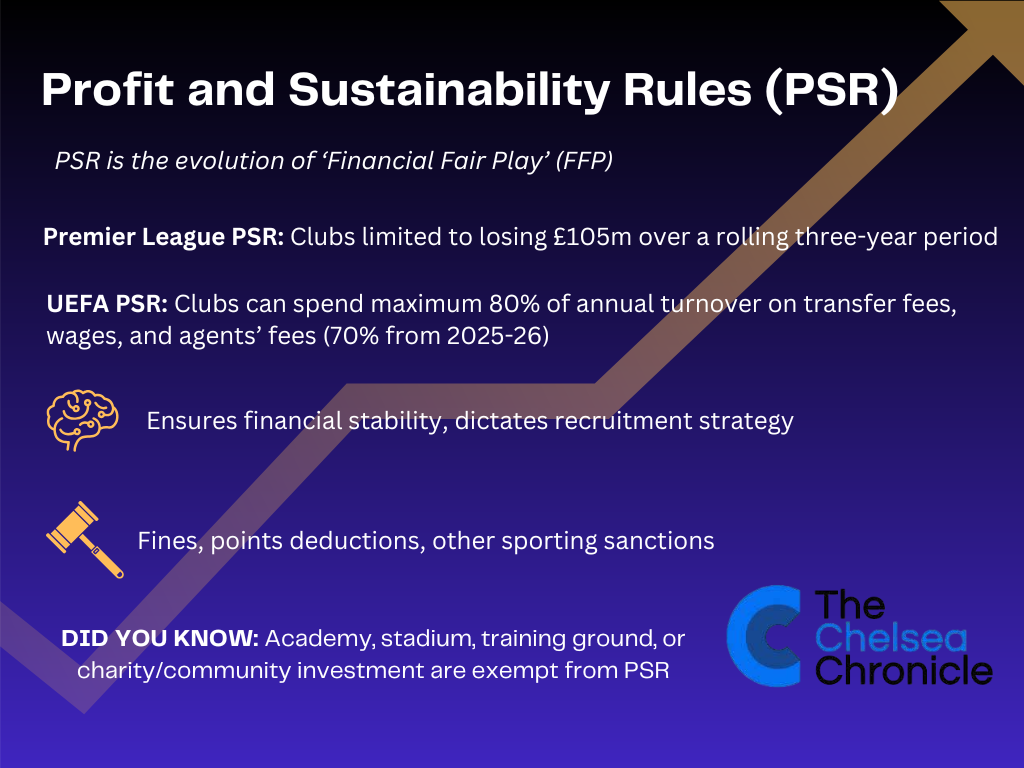
UEFA, however, do not recognise those deals in the context of their own spending regulations.
Given that their spending rules are more restrictive and the fact that they are phasing in a new squad cost control system, compliance with UEFA’s system could prove to be more of a sticky wicket.
Receive a digest of our best Chelsea content each week direct to your mailbox